
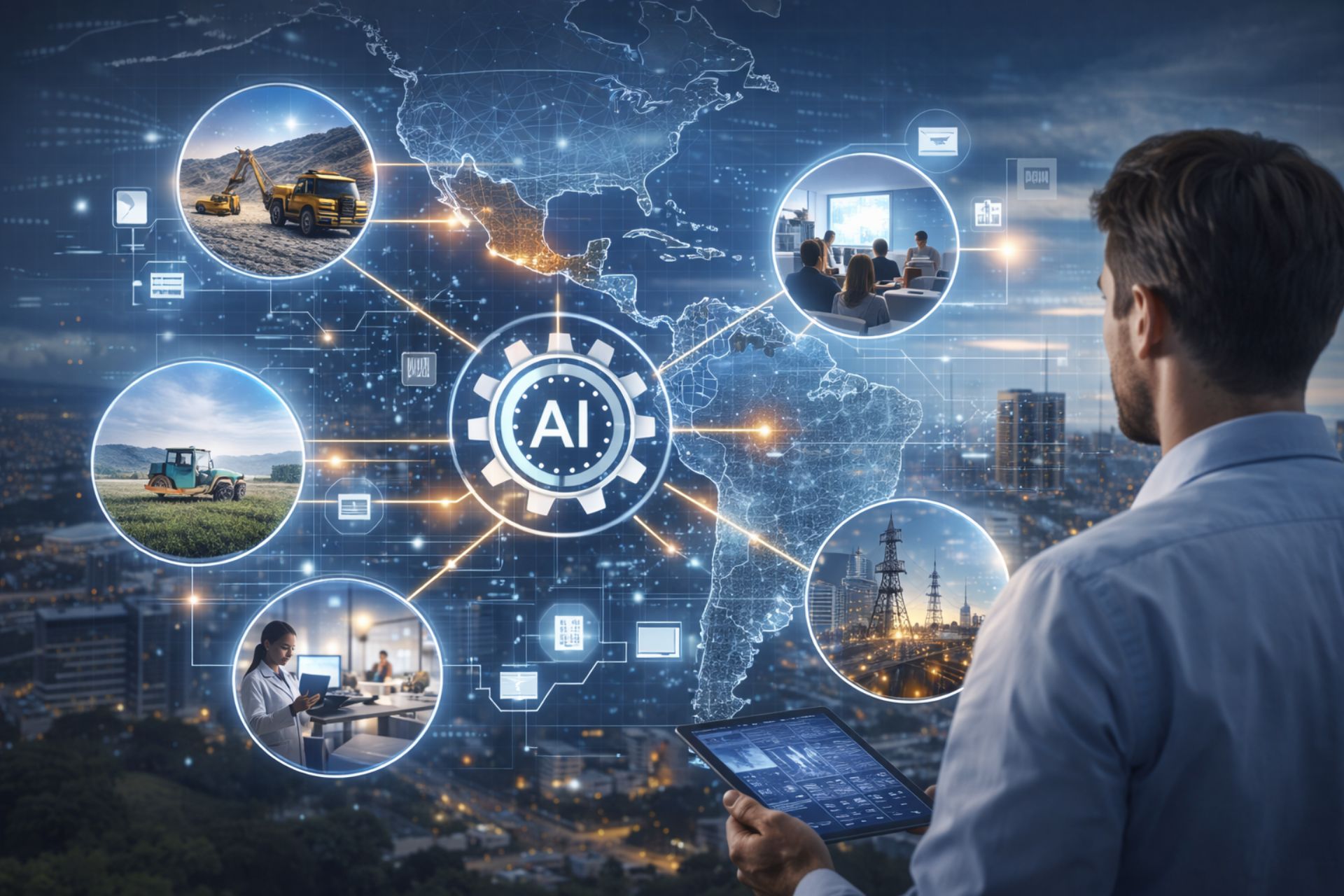
Why the integration of IA is now a strategic priority in LATM
The artificial intelligence integration in Latin America and Peru has become a strategic priority for sectors such as mining, agro-industry, education, energy, manufacturing and services. However, despite the increase in investment and the adoption of IA solutions, many organizations fail to scale up their initiatives or capture sustained value.
The problem is not usually the model of IA. The real challenge is in the lack of integration between artificial intelligence and operating, data and business systems.
In this context, integration becomes the real enabler of digital transformation with IA in the region.
The context of the IA in Peru and Latin America
The companies in LATAM operate in environments of high technological and operational complexity:
- heterogeneous infrastructure and legacy systems.
- Operations distributed geographically, many in rural or remote areas.
- Extensive and changing regulatory frameworks.
- Pressure to improve productivity without neglecting sustainability and social responsibility.
- Specialised digital talent breeches.
In the case of Peru, this complexity is evident in key industries such as mining and agribusiness, where highly technical operations with traditional systems coexist.
How artificial intelligence generates value in multiple industries
The adoption of IA in Peru and Latin America responds to common strategic objectives:
- Process optimization and operational efficiency.
- Reduction of failures and interruptions by predictive models.
- Safety, traceability and policy compliance.
- Better decision-making based on integrated data.
These objectives are cross-cutting across sectors, from mining operations to educational institutions and service companies.
Cases of use of IA in Peru and LATAM
In Latin America, and particularly in Peru, IA generates value when it is properly integrated into existing systems.
A in mining
- Predictive maintenance of critical assets.
- Real-time optimization of production processes.
- Data analysis for operational security.
- Environmental monitoring and strengthening of ESG performance.
A in agribusiness
- Predicting performance and quality.
- Integration of IA with ERPs and logistics systems.
- Automation of administrative processes.
- Efficient use of resources such as water and energy.
IA in education
- Predictive analysis for student retention.
- Customization of LMS-integrated learning.
- Operational optimization in admissions and academic management.
IA in industry, energy and services
- Productive optimization and quality control.
- Forecasting of demand in energy and utilities.
- Process automation and improvement of customer experience.
In all cases, the value depends on integrating data from ERPs, CRMs, OT systems, sensors, digital platforms and legacy systems.
The frequent problem: A without integration
Many IA initiatives in Latin America face similar patterns:
- Pilots that don't climb.
- Models that do not access reliable data.
- Solutions disconnected from real processes.
- Manual Interventions Unit.
These are not algorithm failures. They are challenges of architecture and integration.
The strategic role of integrationist in IA projects
For the integration of artificial intelligence in Peru and LATAM to generate sustainable results, a key profile is needed: integrationists with IA capabilities.
This role allows:
- Connect IT, OT and digital platforms.
- Orquest reliable data flows for IA models.
- Integrate IA solutions into real operating processes.
- Design scalable and adaptable architectures.
- Incorporate data security and governance from design.
In markets such as Peruvian, where technological diversity is high, this role is particularly critical.
Enablers for successful IA integration
Organizations that manage to capture real value with IA share certain elements:
- Solid integration architecture.
- Data management with a focus on quality and traceability.
- Scalable platforms in hybrid environments.
- Robust cybersecurity.
- Adoption and training of local talent.
Conclusion: IA and integration are a single conversation
Artificial intelligence in Latin America and Peru is no longer a future trend; it is a competitive need. But its impact depends on how it is integrated into existing systems.
The organizations that understand that IA + technological integration is the same strategy will be better positioned to improve productivity, resilience and sustainability in a demanding regional environment.
The competitive advantage does not come only from the algorithm. It comes from the architecture that connects it to the business.

